
RIPPED OFF
(NON) EMPTY PACKAGING
Empty containers containing the residue of a hazardous material must be offered and shipped as if they contained a greater quantity of that material.
Relax, as the Department of Transportation (DOT), Pipeline and Hazardous Material Safety Administration (PHMSA) in 49 CFR 173.29 seems to insinuate, the requirements in Subchapter C don’t apply if one simply removes, obliterates, or covers the hazardous material shipping names, identification numbers markings, the hazard warning labels and placards. And even that would be unnecessary if containers were not visible, when transported inside a transport vehicle or a freight container.
No, no, no! The aforementioned is allowed only if; the containers are unused or completely cleaned of residue and purged of vapors to remove potential hazards. Meaning empty? Or refilled with a material, stripping the residue’s hazards to the extent that the absorbed residue no longer meets any hazard class and is not a hazardous substance, hazardous waste or marine pollutant. Basically an unregulated material? but
Sure 173.29(c) negates the hazardous material shipping paper requirements in Subpart C and the placarding requirements in Subpart F, for non-bulk shipments in Table 2 of 172.504 when collected and transported by a contract or private carrier for reconditioning, remanufacture or reuse.
Out of Subpart C Shipping Papers and Subpart F Placards, but not Subchapter C of the Hazardous Material Regulations. Limited quantity material containing residue and most Division 2.2 non-flammable gas, with no subsidiary hazard, once below 29.0 psig at 68 °F are the only two exceptions from the Subchapter C requirements.
Tread lightly, as the exceptions do not carry over to material poisonous by inhalation or packaging containing residue shipped under the subsidiary placarding provisions in 172.505. Which could require two placards for one material when the primary hazard class placard does not display a material's most dangerous hazards.
DOT packaging which contains a residue of an elevated temperature material or that once contained a hazardous substance threshold, “may” remain marked in the same manner as when it contained a greater quantity of the material, even though it no longer meets the definition in 171.8 for an elevated temperature material or hazardous substance.
On the shipping paper, PHMSA encourages the use of, but only mandates tank cars and smokeless powder packaging containing residue to include the words “RESIDUE : Last Contained ***” in the shipping descriptions under paragraph 172.203(e) and 173.29(f), respectively.
The Environmental Protection Agency's (EPA) empty hazardous waste container requirements are in 40 CFR Section 261.7 under the Solid Waste Regulations.
Occupational Safety and Health Administration (OSHA) never defines the word, empty packaging. However, 29 CFR Section 1910.1201 requires the DOT marks, labels and placards be retained until the freight container, rail car, motor vehicle or transport vehicle is sufficiently cleaned of residue and purged of vapors to remove any potential hazards.
PHMSA doesn’t regulate empty containers, they regulate non-empty containers, because empty containers are not regulated.
See you soon.
Be Safe!
Robert J. Keegan
Publisher and President
Hazardous Materials Publishing Company
Transportation Skills Programs Inc.
610-587-3978
Hazmat.tsp@gmail.com
** If you are located in Hawaii, Alaska, or Puerto Rico, email us directly: lisa@hazmat-tsp.com with your order information (Name, Company, ship to, bill to, number of books) and please include a phone number to call you. Thank you!
PLEASE NOTE WE CANNOT SHIP TO P.O. BOX. Thank you!
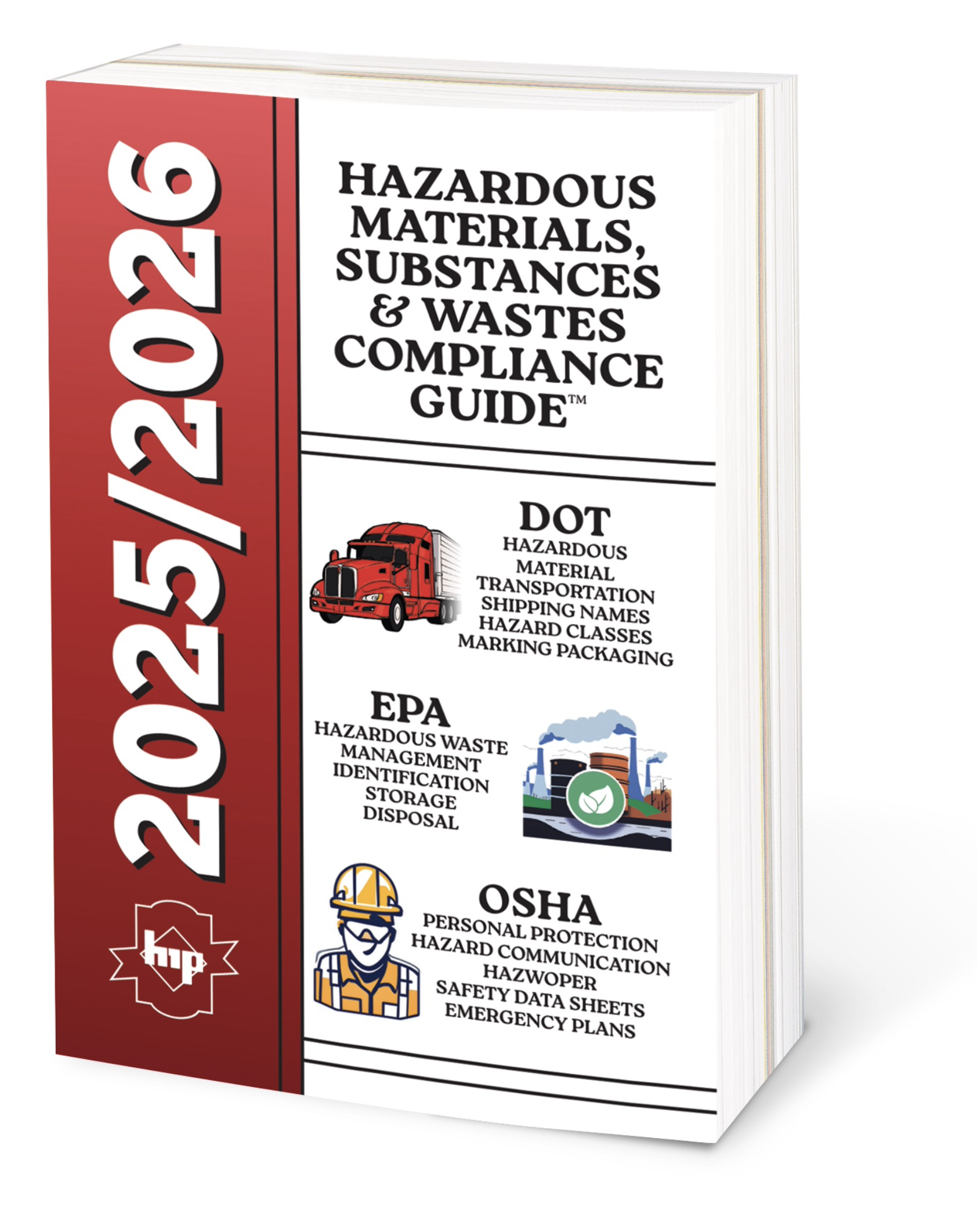
The 2025/2026 Compliance guides with the Emergency Response Guidebook contain the most up-to-date mandatory regulations covering the activities of all HAZMAT/WASTE Employees and Employers engaged in any activity, taking place in any location involving hazardous materials, chemicals, substances, or wastes.
These are the only available Compliance Guides that provide all the critical interfacing DOT/EPA/OSHA Hazard Communication and Compliance requirements for Hazardous Materials, Chemicals, Substances, and Wastes.